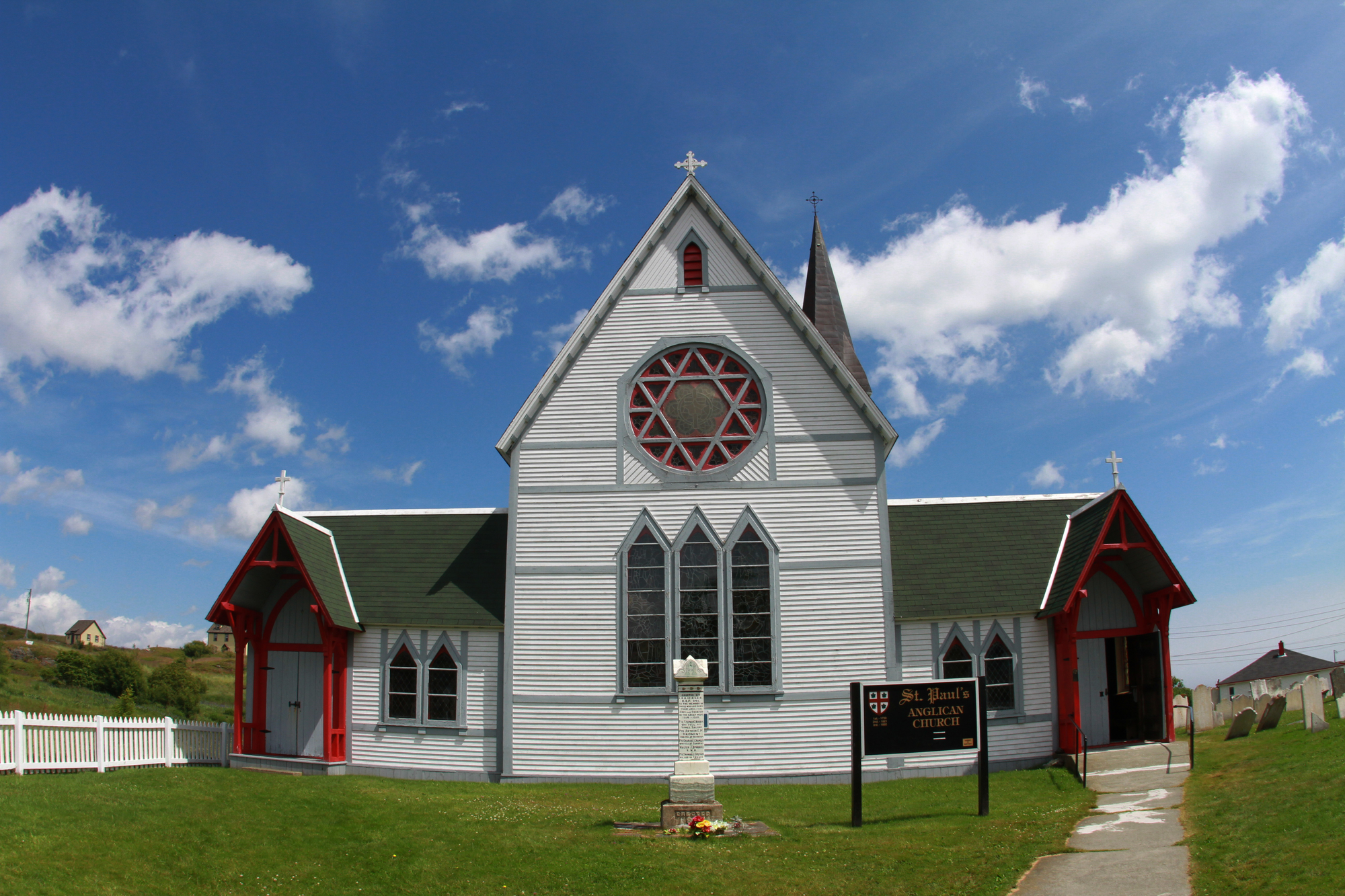
St. Paul's Anglican Church
Registered Name: THE ANGLICAN PARISH OF TRINITY
Business No: 107020232RR0033
This organization is designated by Canada Revenue Agency (CRA) as a registered charity. They comply with the CRA's requirements and have been issued a charitable registration number.
This charity is fully set up with CanadaHelps, allowing for faster donation processing and access to more features
St. Paul’s Anglican Church is a timber-framed church built between 1892 and 1894 in the Gothic Revival style of architecture. A small cemetery surrounds it and sits on a grassy lot on Church Road in the historic Town of Trinity, NL.
St. Paul’s was designated a Registered Heritage Structure by the Heritage Foundation of Newfoundland and Labrador in 1987 due to its aesthetic and historic value.
The Anglican Church has a long history in Trinity, dating back to 1729. The current St. Paul’s is the third Anglican church in Trinity, constructed in 1892 to replace the crumbling 1820 building (a building which had, in turn, been built to replace the original 1729 church on that site.)
The current church's size and scale indicate the large Anglican community in Trinity at the turn of the twentieth century. With a capacity of 600 people, St. Paul’s is a testament to the central role that organized religion played during the period.
The design for St. Paul’s came from Stephen C. Earle, a noted American architect from Worchester, Massachusetts. However, the design was not intended for Trinity; in fact Earle may have been unaware of its use here.
The architectural drawings were initially created for the Anglican church in Digby, NS. By the time the St. Paul’s Building Committee purchased the drawings from Digby’s minister, the plans had already been re-used for Christ Church in Windsor, Nova Scotia.
Construction started on St. Paul’s on March 20, 1892, and was completed on November 13, 1894. Carpenter Caleb Marshall led the construction of St. Paul’s. Marshall was known for his skilled craftsmanship in the construction of St. Andrew’s Anglican Church in Brooklyn (also a Registered Heritage Structure). He would go on to build St. James Anglican Church in King’s Cove. Like most churches built in Newfoundland and Labrador during this period, the building of St. Paul’s was funded by its parishioners.
St. Paul’s is an excellent example of the late Gothic Revival style in its layout and decoration. The Gothic interior features are very ornate, particularly compared to the more minimalist pre-Ecclesiological churches in the region. This is especially notable in the intricate hammer-beam roof frame and pointed arch arcades, left unpainted to display the natural wood. The “Stick Style” variant of Gothic Revival, also seen in the mock-Tudor beams on the church’s steeple, was likely influenced by the prevalence of this style in the architect’s native New England. St. Paul’s features a classic late Gothic Revival centre-and-side-aisle layout and a large tower with a spire. Other Gothic features include arched windows and doors, a large rose window, and clerestory windows.
The church has seen remarkably few alterations since its construction. The tower was rebuilt in 1981, but the reconstruction retained its original Gothic features. As such, St. Paul’s is one of the province’s most elaborate examples of the Gothic style in a wooden church.
Source: Statement of Significance, Heritage NL
REGISTERED CHARITY ADDRESS
PO BOX 119
PORT REXTON, NL, A0C 2H0
Why CanadaHelps
Why donate to St. Paul's Anglican Church on CanadaHelps?

About CanadaHelps
We're a registered charity that provides simple and convenient tools to manage your charitable giving to any Canadian charity of your choice.
Where Your Gift Goes
Charities that set up to receive electronic funds transfers from us will receive your donation quickly, so it can be put to work faster.
Tax Benefits of Donating
Get an instant tax receipt, manage all your tax receipts in one place, and make a difference while maximizing your tax credits with ease.