As the saying goes – it takes a village, and charities are no exception to this rule. The village is simply made up of volunteers. Volunteers are the lifeblood of the charitable sector. They embody generosity and selflessness – offering up their time, skills and/or resources to charities without receiving compensation in return.
Volunteers Create a More Generous Society
Research by CanadaHelps shows that individuals who are more engaged with the communities they live in are more generous, and give more to charities. In a world where an increasing number of people feel socially isolated, volunteers continue to offer up their time and labour to build stronger and more resilient communities.
In this piece, unpack a step-by-step strategy highlighting how charitable organizations can build robust volunteer programs that recruit the right people, engage volunteers in worthwhile causes and foster long-term relationships that fuel the impact of charitable organizations.
How to Start a Volunteer Program?
Setting up a robust volunteering program at your organization takes some careful planning and preparation. Start by understanding the volunteering needs of your charity – map out what type of time commitment and special skills your organization needs. Following this, plan out the trajectory you envision volunteers following.
Volunteers typically fit into one of these four buckets:
- Awareness spreaders or champions
- Special or skilled talent
- Fundraisers
- Board members
Consider which type(s) of volunteers your organization needs. Then determine the type of time commitment associated with the role. Be upfront, but flexible, about what you’re asking for. Based on the type of volunteers you need, the time and scheduling commitments you will ask for typically fit under one of four categories:
Volunteer categories:
- One-time
- As-needed
- Ongoing
- Long-term
Here is an example: a dog rescue charity needs volunteers to walk dogs on a daily basis. Ask yourself these questions:
- What skills and time commitments does this role call for?
- Do you need volunteers who can provide long-term, consistent availability?
- What sort of screening process, supplies and training will your charity have to provide in order to onboard the volunteers and ensure they are empowered to carry out this task?
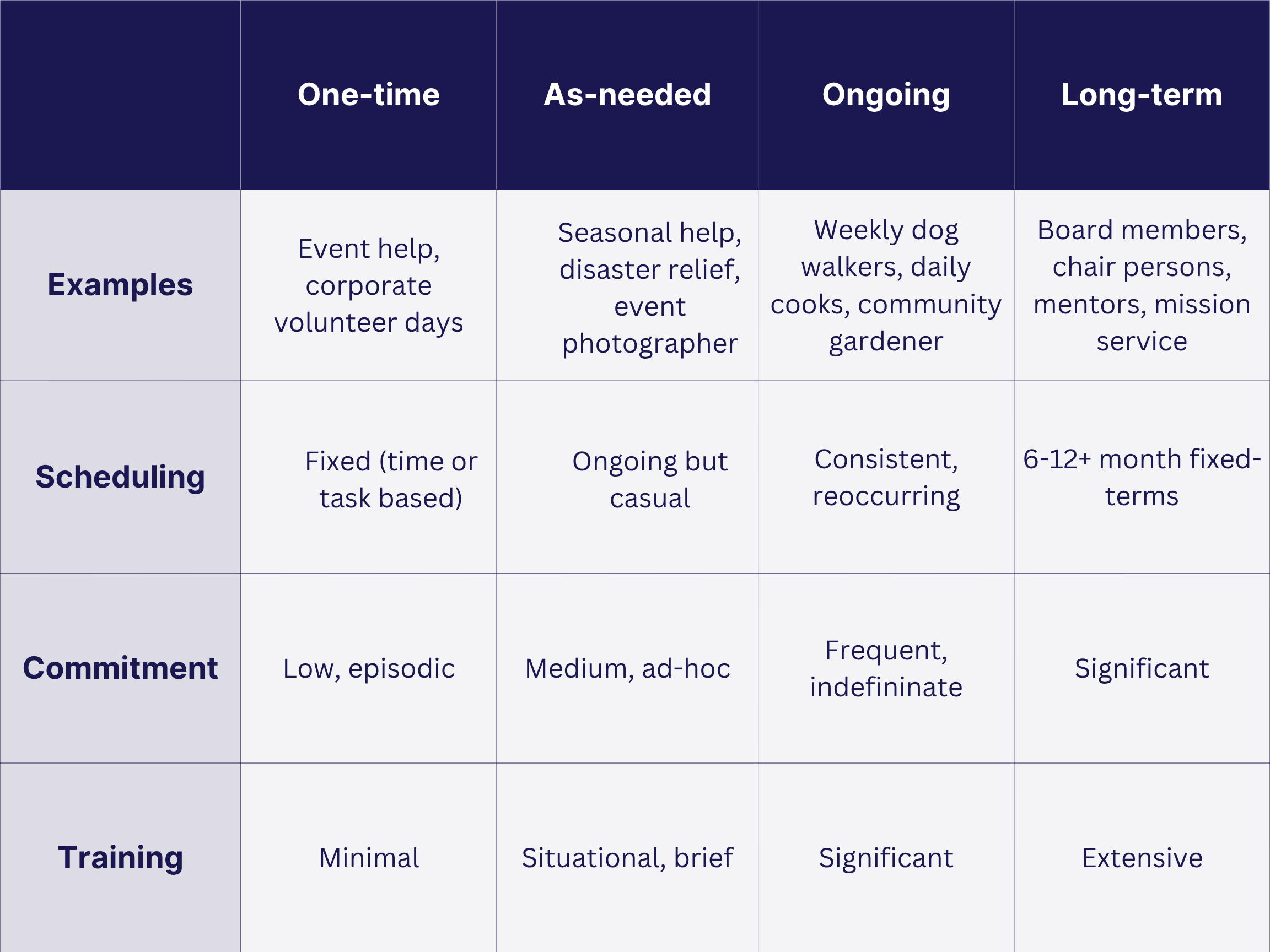
After you nail down the type of volunteer and time commitment you need, and determine the corresponding time and frequency requirements, continue on and map out the journey volunteers will follow to both onboard and get acquainted with your organization.
Design your volunteer journey:
It’s important for charities to think through the end-to-end journey that prospective volunteers will follow. This means, the progression from the moment they apply to become a volunteer with your organization – to the level of ongoing supervision and scheduling work that will be required once they have been brought aboard and trained.
Let’s take the example of a dog rescue charity that needs volunteers on a daily basis to walk the dogs in their care. Begin from the first application point of contact with your organization and subsequently walk through the various stages the volunteer will pass through using the steps outlined below.
Application: set up an online form on your website with fields to gather the required information. If your organization requires specific equipment or hard skills, add them as yes/no boxes in the application, common examples of this are:
- Do you have a driver’s licence?
- Do you have access to your own vehicle?
Screening or vetting: consider the background and identification checks you need, including a criminal record check or personal reference.
Orientation and/or training: your organization is responsible for onboarding volunteers and providing them with instruction about how to carry out the required tasks.
- What supplies and/or safety equipment is required to complete the volunteer work? (Ex. dog leashes, gardening tools, aprons etc)
- Will you need to request the volunteer bring in specific items?
Ongoing volunteer management: Determine what level of supervision or ongoing oversight is needed from your charity in order to manage the volunteering program. Some needs to consider include:
- Scheduling
- Communication
- Supervision
- Access to facilities
Recruiting high-value charity volunteers
It should go without saying that the cornerstone of any volunteer program is recruiting the right people. Yet many charities struggle with where and how to find them. If your organization is facing this challenge, read on for a range of digital and in-person strategies you can employ to help attract new volunteers.
Digital-first approaches
In our online world, recruiting new volunteers digitally is essential for a growing charity.
Email marketing: send email campaigns to your list and in your newsletter asking for volunteers.
Website optimization: put a landing page about volunteering on your website with a frictionless volunteer signup form. For charities without a website, ensure you have built out a robust CanadaHelps Charity Profile.
- Write role descriptions and define the skills required
- Provide time commitment information
- Instead of saying “we need volunteers,” say, “we need 2-3 volunteers daily from 12–3 pm to walk dogs”.
Facebook/social media groups: find local or community groups that allow you to put out a call for volunteers. Search for groups with an engaged membership and try to narrow down using other shared criteria – location, interest, activity etc.
Networking-driven strategies
Neighbourhood forums or apps: apps such as Nextdoor can be a fruitful place to prospect for volunteers, or make posts calling for volunteers in your local area.
Professional networking groups: whether you meet in person or online tap into a professional network, especially one centered around impact.
Leverage your personal connections for referrals: put the word out to people within your personal and professional circles.
Partnership-driven approaches
Build partnerships and connections with organizations in your community that can provide you access to a network of engaged citizens who may want to volunteer for your cause – some channels we suggest for partnership-building are:
- Schools
- Community or recreation centres
- Faith-based organizations
In-person strategies
Making your charity visible within your community can be a worthwhile channel to recruit volunteers. We suggest advertising or setting up a booth through these channels:
- Farmer’s markets
- Street fairs
- Local festivals
- Community bulletin boards
If you’re setting up a booth at a community event, have an iPad or clipboard where interested individuals can join your emailing list – this way you can grow your list of volunteering prospects.
How to retain volunteers and nurture volunteering relationships
Now that you have recruited the volunteers you need, or better-yet built processes that enable ongoing recruitment, the next step is to design a program of volunteering work that helps you both retain and nurture the right people – and keep them coming back to help your cause succeed. Here are five strategies to help charities engage volunteers:
Organization and communication: it may sound obvious, but consistent communication alongside strong planning and execution of volunteer opportunities is the bread and butter of retaining volunteers. There’s no faster way to lose people than unclear instructions, gaps in response and missing important details like addresses, phone numbers and what to bring or wear. To streamline organization we recommend using a volunteer management software platform.
Provide opportunities for meaningful work: offering fulfilling tasks that people enjoy doing will keep them coming back. Drill down on this point – it’s the most important aspect of volunteer retention. Here are some ways to ensure volunteering work is meaningful:
- Ask what type of work they want to do during the recruitment process
- Give volunteers tasks that align with their skills and preferences
- Empower your volunteers to take ownership of their role
Diversify volunteer tasks and opportunities: this helps mitigate compassion fatigue and allows you to rotate work that people find undesirable. Tips to put diversification into action:
- Give options of different tasks
- Listen and be flexible
- Create feedback loops where volunteers can express preferences (surveys, anonymous feedback forums etc)
Emphasize community: this looks like creating opportunities to build human connections between volunteers, staff and sometimes program participants or other community members. Community is key to nurturing volunteers because:
- A more connected society is a more charitable one
- Volunteers are often motivated by a desire to participate in the community, strengthen social ties and connect with like-minded individuals
Show gratitude – first and always: retaining and nurturing volunteers begins and ends with giving thanks for their contributions. Check in regularly with your volunteers to ensure they feel valued – we also encourage charities to:
- Show appreciation through regular thank you emails
- Acknowledge their contributions in-person at events
- Look for opportunities to spotlight their generosity – on your website, on social media or even the walls of your office.
Put Your New Volunteer Strategy into Action
At a time when many people feel a lack of meaningful connection to the communities they live in, volunteers continue to step forward – contributing their time, skills or commitment to building a more charitable society.
Throughout this piece, we explored a step-by-step approach to building strong volunteer programs, outlining how charitable organizations can attract the right individuals, create meaningful engagement opportunities, and cultivate lasting relationships that drive long-term impact.
Get expert tips, trends, and resources delivered to your inbox monthly.Stay Ahead with Digital Fundraising and Nonprofit Insights