Giving Season, the stretch from early October through the very last moments of December 31st is the most influential fundraising period of the year for Canadian charities. Donor activity surges, tax-time incentives create urgency, and cultural traditions inspire generosity across the country. For charities, this window represents a rare and powerful opportunity to raise a significant portion of their annual revenue.
Few organizations have a deeper understanding of how to maximize giving season than CanadaHelps. As a charity ourselves and a platform facilitating online giving for more than 85,000 registered charities, Giving Season is our busiest time of year.
This blog is adapted from our recent webinar, where Christina Adams, Director of Donor Marketing, provided a peek behind-the-scenes at how CanadaHelps plans, builds, and executes its Giving Season strategy. Read on to learn how you can leverage similar strategies for Giving Season or hear directly from Christina in our webinar.

What is CanadaHelps Donor Services?
CanadaHelps started as a project by three university students to ensure that charities didn’t get left behind during the dotcom boom of the early 2000s. In our first year, we helped facilitate $150,000 through our website. Since then, we’ve gone on to facilitate over $3.7 billion donated to Canadian charities.
Beyond one-time donations, we provide a range of giving options for donors looking to support their favourite charities and, causes and solutions for donors looking for charitable gifts in our comprehensive range of giving options. We offer:
- One-time & monthly donations
- eCard dedications
- Cause funds
- Donation centre for humanitarian crises
- Donations of stocks, bonds & mutual funds
- Fundraisers
- Charitable gift guide
- Gift cards
More than 50% of CanadaHelps donations are raised during Giving Season. 33% of that is in December alone.
Every year, the Giving Season becomes more critical for charities. As a charity ourselves, it’s the same for CanadaHelps.
-
- Up to one-third of all charitable revenue arrives in December.
- 10% of annual donations happen in the last three days of the year.
- Giving Tuesday and December 31 are consistently the two highest donation days.
When we polled the room on the question “how important is the Giving Season to your organization”, we discovered that 30% of attendees were unsure of how critical it was for their organization. We highly encourage charities to monitor the Giving Season and assess how much of their annual revenue this period accounts for. After “unsure”, the second most popular response to the question above was charities stating less than 10% of your revenue and after that, roughly 20-30%.
How to Get Ready for Giving Season
1.Plan Early: “Giving Season Is on Our Minds All Year Long”
CanadaHelps begins preparing months in advance — often with content creation starting in the spring and detailed planning in mid-September. This year we launched a new brand with a new tagline “Generosity is right here,” which became a key part of our Giving Season story. We created our first ever public service announcement voiced by Cobie Smulders (Robin from “How I Met Your Mother.” We also created a children’s book called Violet’s Song, to support conversations about generosity and kindness at an early age.
Could we build a more generous world?

When Fall comes around that’s when the detailed planning begins. We set direction focusing on three main themes.
CanadaHelps main three themes are:
- Charitable holiday gift-giving,
- GivingTuesday
- Charitable tax credits
These themes all inform our end-of-year appeals. We segment our audience to ensure messaging is tailored and to prevent appeal fatigue.
Your Charity Can Do This Too:
Even if you can’t start early every year, you can adopt a scaled-down version of this roadmap.
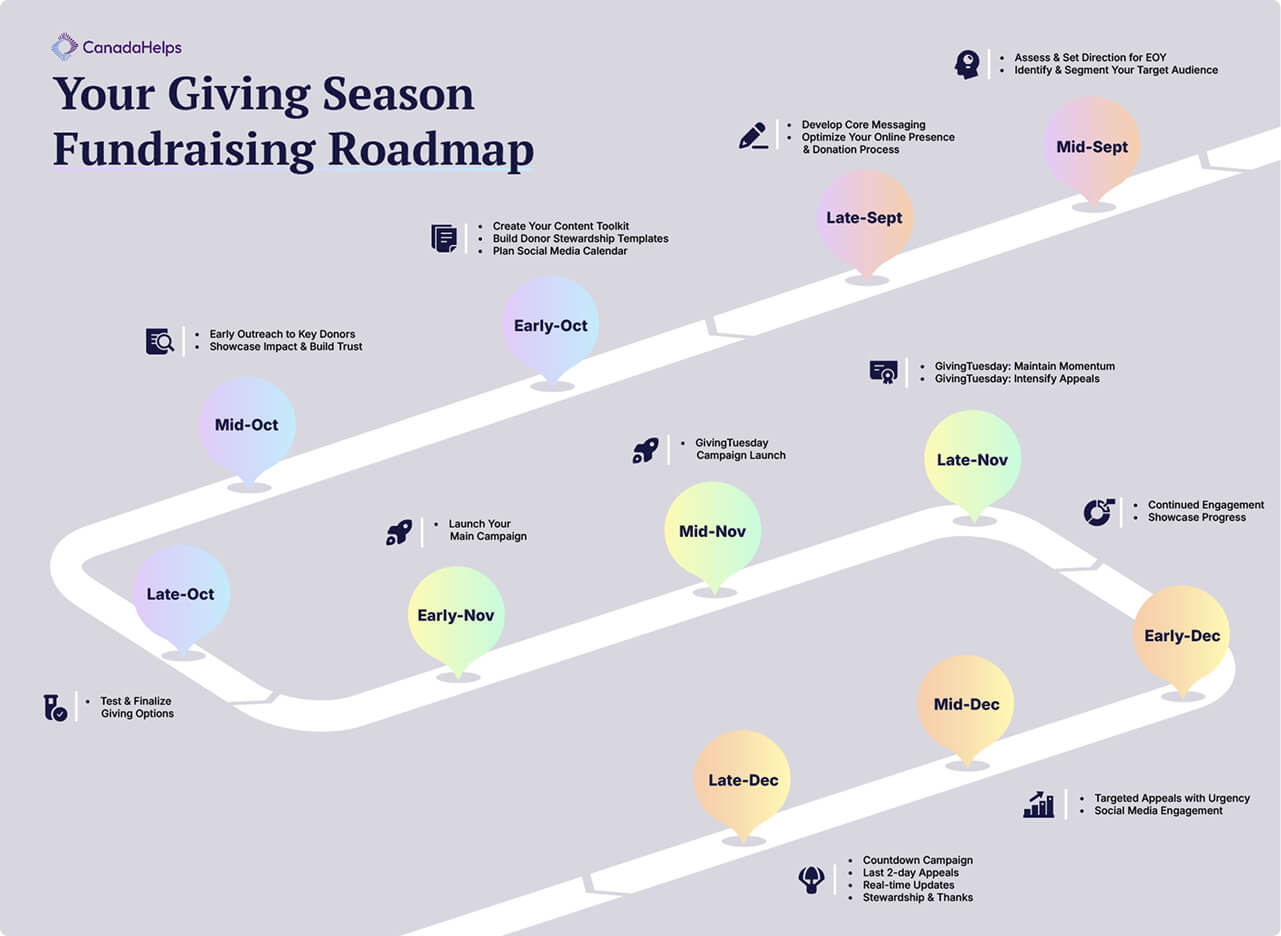
Spring / Summer
Lay the groundwork for Giving Season and start early on your foundational pieces.
- Identify your big themes
- Produce cornerstone content (video, stories, testimonials)
- Start thinking about partners or potential matching gift donors
Fall (begin detailed planning)
- Establish messaging themes:
- charitable holiday gift-giving
- GivingTuesday
- charitable tax credits
- Develop key messaging that matches your themes and ties them together
- Last minute, meaningful gifts
- Join the movement
- Maximize your tax return
- “Generosity is right here”
- Segment and maintain your audience
- Monthly donors
- Lapsed donors (2+ years)
- High-value donors
- Securities donors (stocks, bonds, mutual funds)
- New subscribers who haven’t donated
- Account holders vs. non-account holders
- Remove those who haven’t interacted with emails in over X months
- Conduct a post-mortem: Review what worked (and didn’t) last year
Get your own condensed fundraising roadmap here, with a number of resources you can leverage straight out of the box.
2. Prepare your website and donation process
From Fall onwards, we begin optimizing our key landing pages and updating any information, imagery, and videos, on pages we intend to drive year-end traffic to. For example we update information on our securities pages for those donors who want to donate investments, stocks, and bonds.
Our key Giving Season landing pages:
- gift guide
- GivingTuesday
- securities
- tax incentives
- special content
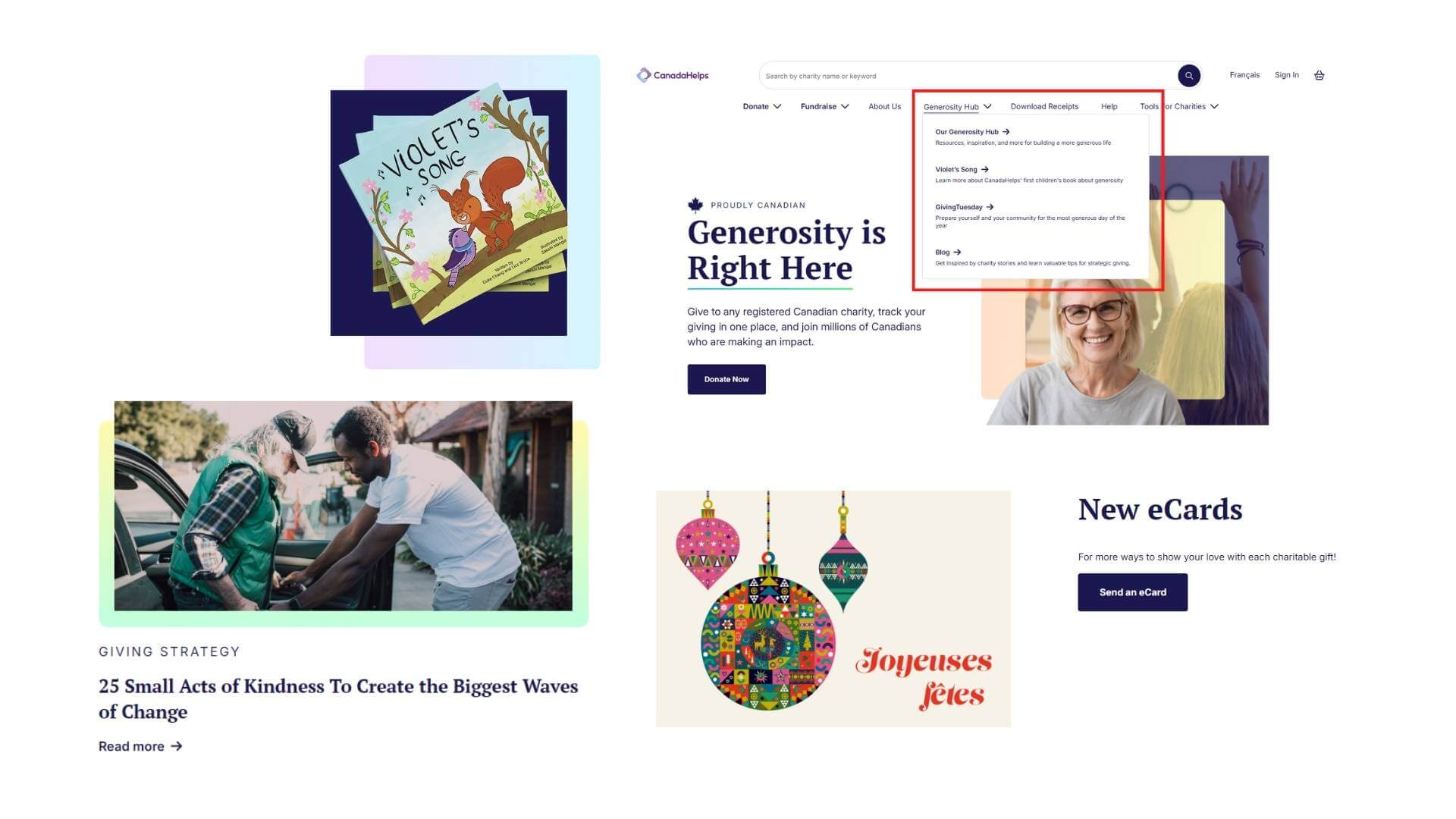
A significant part of updating your website for Giving Season is optimizing your donation process. We recommend reducing friction by using a donation form optimized for online donations. We suggest creating a specific GivingTuesday or Giving Season donation form. This lets people know they are in the right place and gets them excited to support the specific goals of your campaign.
Check out this awesome example from DTRC Dancer Transition Resource Centre They have added a fundraising thermometer and other Giving Season specific copy to encourage donations. We’ve made it easy for you to create your own Giving Season form – download your free to use backgrounds here.

If you don’t have a website to embed a form – no worries. Claim your CanadaHelps Profile page and bring your donors straight there. It’s also a great place to find new donors.
3. Warm Up Your Donors
We start preparing our donors with a soft ramp-up to Giving Season in October. We publish content across our channels themed around special days, such as food security for Thanksgiving, and pepper in messaging about gift-giving and tax credits.
Examples of our warm-up communications include talking to your donors about
- Awareness days associated with generosity
- The benefits of donating securities
- Tax incentives
- Reach out to key donors for potential matching campaigns
- Connect with young people to get them excited
Launching your Giving Season Campaigns
1. Email Communications
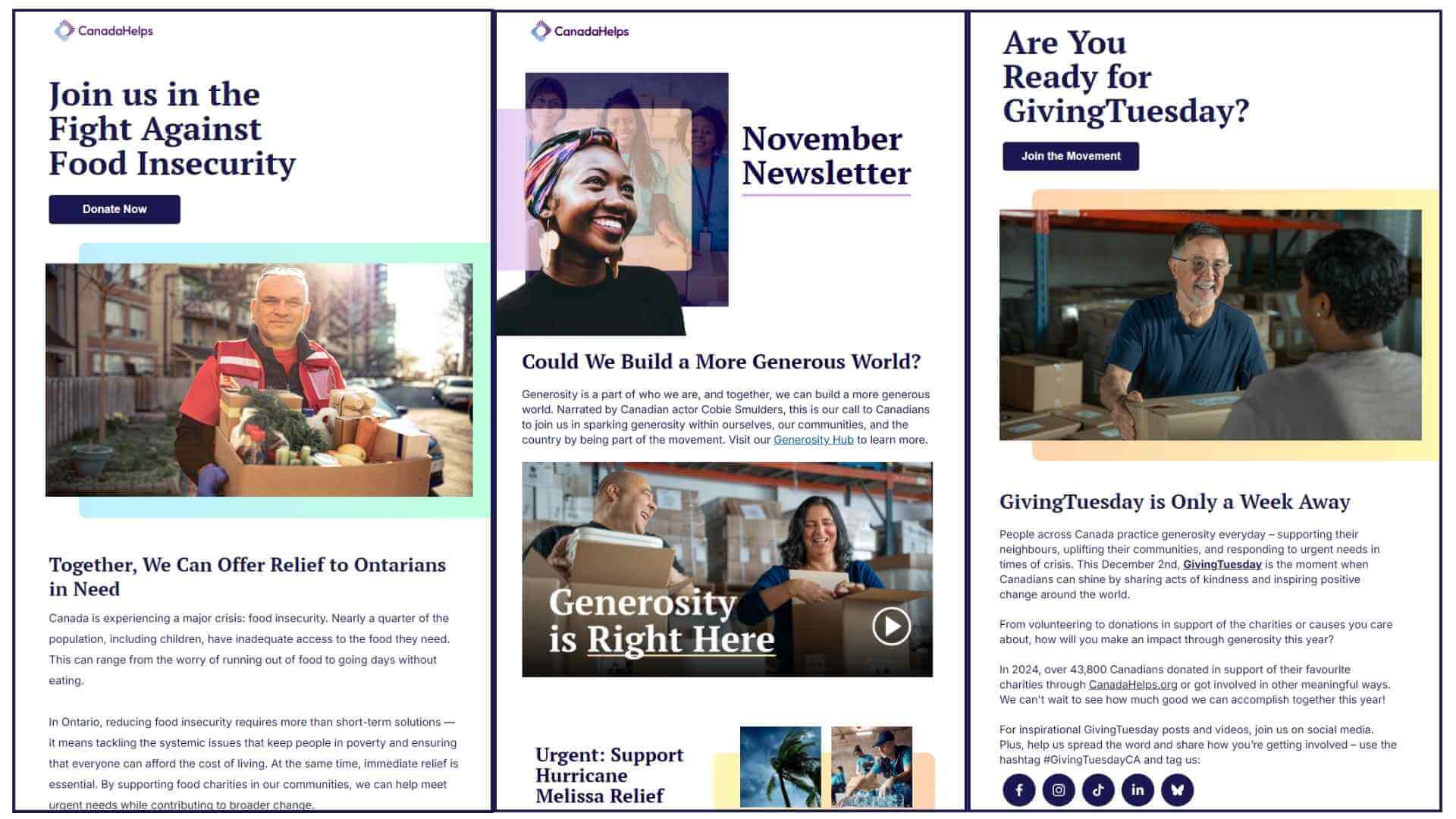
We sent over 50 emails last Giving Season. But don’t worry, no one received all 50 emails. This number includes plenty of email list segmentation, and resends to those that didn’t open. Begin by mapping out the key emails you will be sending, and next use the list segments that make sense for your organization.
Some examples of email list segments you could use:
- High value donors
- Lapsed donors
- Last year donors
- Excluding donors who have already given this year
During our live poll, most audience members (71%) were reaching out 5 or fewer times through email during the Giving Season.
Key Giving Season Emails:
- GivingTuesday “save the date”
- GivingTuesday AM
- Giving Tuesday PM
- Post GivingTuesday thank-you & results
- Gift Guide highlights
- Gift Guide last minute gifts
- Dec 27 – thank-you from CEO
- Dec 30 – less than 48 h to give
- Dec 31 – morning & evening
We often get questions about the optimal email cadence and how many emails is too much. Our best advice is to send emails based on whether you have a new message or perspective to share, and not based on hitting a specific target number. You may find that the vast majority of your audience is happy to receive emails as long as they are valuable or provide further context to your mission.
2. Social Media
Social media is a great channel for GivingTuesday. Since it’s a global movement, there is chatter all across the social networks celebrating the many forms of generosity that exist. Look for and use the hashtag #GivingTuesday or #GivingTuesdayCA on whichever social networks you engage in the most.
Recently, we’ve been re-examining how we approach social media at CanadaHelps. We’re aspiring to establish more of a personal connection. Instead of treating social media as a purely outbound distribution channel, try to engage with your supporters – respond, spotlight them and build community.
Lean into content creation, especially video content creation that features your work. There’s many ways now to create short-form video content like reels and TikToks that grab attention.
Key Strategies:
- Build an editorial content calendar for your social media
- Establish personal connections and build your community
- Lean into video content creation
3. Other Considerations
Email and social media campaigns are must-haves in a Giving Season campaign. You may want to consider additional opportunities across paid ads, paid search engine marketing, email signatures (particularly for staff with public facing roles), and website notification banners. These actions can provide a lift for your donations and help raise awareness for your campaign.
Evaluating Your Giving Season Success
At CanadaHelps, we track and measure success in many different ways. One key way to do this and to ensure you’re able to answer “how important is Giving Season to my charity” the next time someone asks, is to download your donation totals during campaign periods.
Here’s how to do it within your CanadaHelps charity account if you’re using CanadaHelps as your fundraising platform:
Other places to look include for Giving Season data
Landing Page Analytics
- Traffic
- Conversion rates
- Acquisition sources
Email Analytics:
- Open rates
- Conversion rates
- Link clicks
Social Media Analytics
- Reach
- Engagement
Having both your donation totals for the period and your channel analytics helps you determine whether it was effective to run that social media campaign, or whether that landing page was worth the time and effort spent. Every year, we analyze, debrief and improve for the next Giving Season – we suggest you implement this feedback loop too.
Webinar Q&A Roundup
Could you share the data on GivingTuesday and why is it worth participating?
Last year, participating charities raised over $16.2 million on Giving Tuesday. Charities that participate in GivingTuesday have been proven to raise more overall.
We recently ran a webinar on GivingTuesday where more of these stats are shared and how charities are creatively tapping into the opportunity. If you want to be inspired by more ideas, check that out here:
What is the optimal number and timing of messages sent for GivingTuesday and End of Year?
This will be unique to your organization, the size of your list and who your donors are. You need to consider how many emails you send to your donors on other topics and if you’ve recently run a campaign. Creating that editorial calendar can help you identify whether you’re running too many communications.
For most charities, it will make sense to educate donors ahead of time, have one email blast on GivingTuesday and then thank donors afterwards. Then begin to segue into end-of-year messaging. Try to flatten those big peaks out a bit so that the communication is not overwhelming on GivingTuesday and December 31st.
How do you standout in an oversaturated space?
Consider what makes your organization unique and differentiated. Are you doing anything differently for your community? What stories can you tell that are specific to your charity and how it is carrying out its mission?
Reach out to those that are interacting with you but haven’t yet donated. It’s worth putting in extra effort to your “warm audience”. There are likely a number of people already curious about your charity and mission.
What are proven strategies for those with small teams and budgets to handle the giving season well, especially during a postal strike?
Leverage the content that you’re creating and revise it just slightly across all the different channels for maximization. That way, you’re only creating focus on one key message for one key segment and then honing it for each of your marketing channels. This both helps you provide focus for your message and helps you batch your work so that you can make content more efficiently.
Having one piece of pillar content, maybe that’s your email series, then taking those messages, those snippets outside of that and putting that on social media and across different spots can make it less of a lift for small teams.
Also lean on resources like CanadaHelps, we have many ready-made templates for your emails, social media and editorial calendars, specifically for teams like yours.
How can I run a matching campaign?
Start the conversation. If you have relationships with your high value donors or any corporate donors to your charity, message them before they’ve made the donation for the year, and see if they’d like to make their gift go further. Let them know how their impact could go further without necessarily increasing their donation.
How can you leverage a match without losing other potential donors once the match is met?
Basing your match amount and timeframe on something that is realistic and data-informed can help you reduce that. It creates urgency during the match time-frame and ensures that the incentive is not too easily reached.
Another way to do this is to provide tiered goals from the get-go. You can see this in the example from Partridge Creek Farm mentioned in our GivingTuesday blog.
What do you do about donor fatigue?
That is something we see in our statistics. We keep a close eye on it. When we notice that someone isn’t engaging with our emails, and hasn’t for some time, we remove them from our communications.
Apart from this, you can also do A-B tests, where you send two emails with a small difference between them like the subject line, or the use of emojis, and see which one performs better. This can help you improve engagement and ensure your emails work best for your audience.
We hope this peek behind the curtain inspires your charity.
Check out our ready made resources for GivingTuesday and Giving Season that make your preparation faster and easier.