Monthly donors support charities in building more stable and predictable revenue streams and it remains a pocket of strong growth in comparison to other giving behaviours. Looking at the numbers in our latest Giving Report, monthly giving reached $86.9 million in 2024, or about $7.2 million per month, up 9% from 2023.
So, you’re convinced of the benefits of a monthly donor program but how do you go about it? This blog post is adapted from the webinar “Tapping Into Monthly Giving Momentum”, where Andrea Thompson and Tiffany Trinidad from FoodShare shared their learnings on monthly giving, having successfully grown their monthly donor program from 16% of their individual giving portfolio in 2018 to 36% in 2024.
If you want to hear directly from FoodShare please watch the webinar replay, or review the slidedeck here.

About FoodShare
FoodShare is a food justice organization, advocating for the right to food, and working to challenge the systemic barriers that keep people from accessing the food they need to thrive.
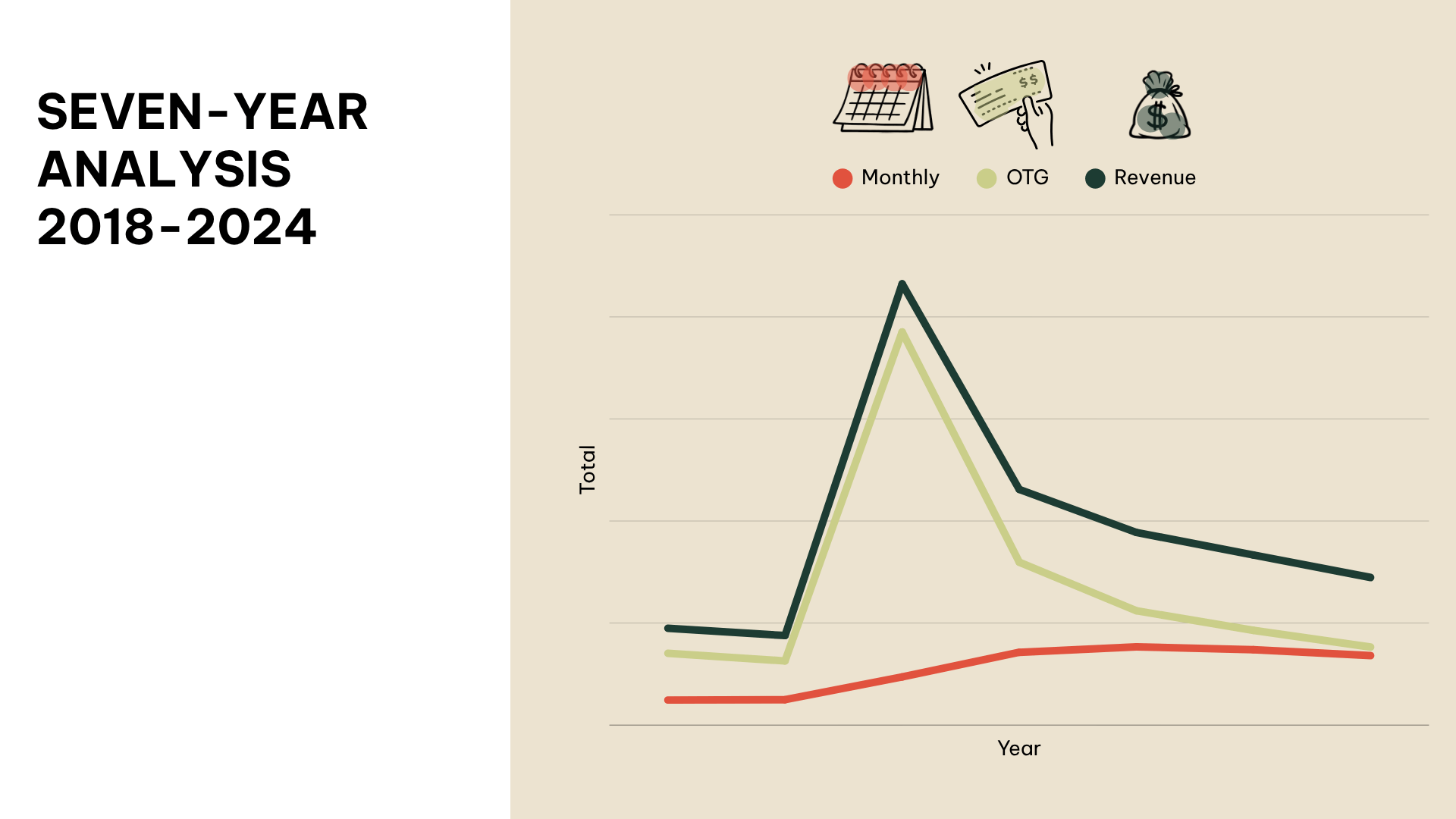
Monthly giving is really important at FoodShare. It helps to provide a stable source of revenue and it is a more effective way to maintain relationships with supporters. Monthly donors are often already committed and are missions and values oriented, so touchpoints are not so much “convincing them to give you funds”, but more about maintaining a shared sense of vision.
Between 2018-2024; we saw a large influx of one-time gifts at the start of the pandemic. While that “emergency funding” tapered off, what remains consistent is the revenue from our monthly giving. In 2024, monthly giving made up 36% of our donor base and 47% of our individual giving revenue.
In terms of retention, our monthly donor retention rate for our monthly donors is at 96%. In comparison, for one time gifts, is at 49%. So it rings true that retention is stronger for monthly donors. These retention rates reflect that monthly donors sign up because they believe in your mission and the work your charity is doing.
Getting Monthly Donors In The Door
Make Your Monthly Giving Program Prominent
This may be an interesting insight – FoodShare does not actually see a large number of conversions from one-time donors to monthly donors. Instead, we onboard people as monthly donors to begin with. Our strategy is to plant the seeds for monthly donations early. Although it isn’t the default option, it features very prominently across our site and direct mail campaigns.
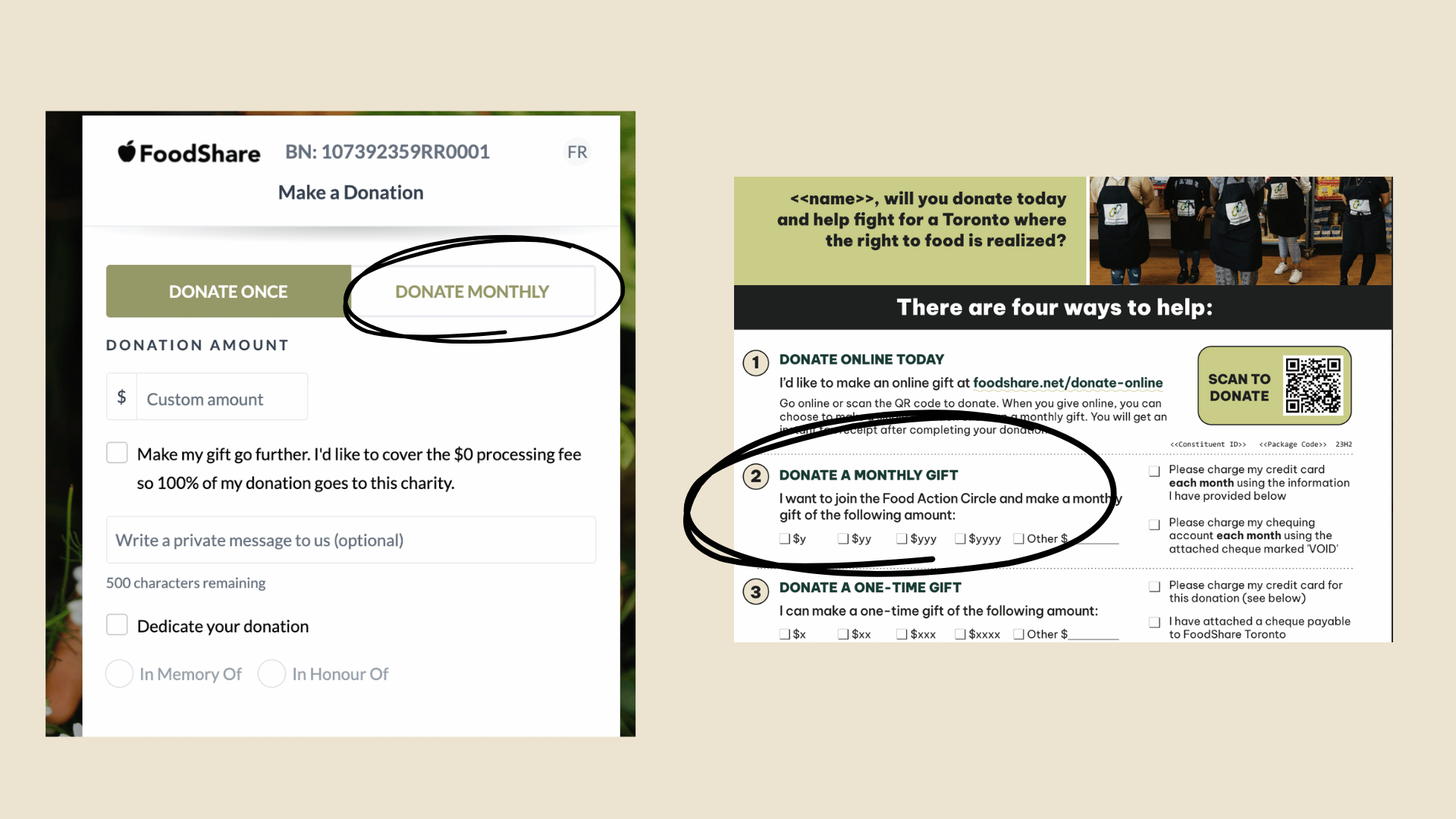
Examples of FoodShare donation asks that highlight monthly giving prominently
CanadaHelps Donation Forms can help you to do just that. With donation forms that put monthly first so that it helps you increase your conversion rate or the “prompt for monthly” feature which increased monthly gift amounts by 15% in our testing. See how it works for yourself in your account.
Educate your donors on monthly
Aside from featuring it prominently, there is an element of education. Providing information about why being a monthly donor is important – to provide continuity and how it makes a big difference for FoodShare, revenue and community impact overall.
Key Messaging
FoodShare doesn’t capture a huge amount of information about donor demographics, prioritizing low barrier to entry for donors. Instead, when tailoring key messaging to our audience, we focus on interest and giving people more of the kinds of things they want to hear about.
Our fundraising team works extremely closely with the communications team to discover what people are engaging with and also not overburdening supporters with communications.
The most important piece is to “make as many people feel part of your work as possible.”
We are a local organization and reach out to folks in Toronto, but we go beyond that by telling stories about specific neighbourhoods and communities. We don’t distinguish who might be a beneficiary or working alongside us in community. People might join us as a recipient at one stage in their life and then, at another point, be able to support our work as a donor.
We had a clear example of that when we provided emergency Good Food box provisions to folks at the height of the pandemic. Someone later reached out to say, “Thank you so much, that got me through a really rough time and I’ve just signed up as a monthly donor.”
We don’t introduce people in our communications as only a “community farmer” or “beneficiary”, we emphasize that these are your friends and neighbours. This also supports us with balancing the dignity and joy in our messaging as we address a serious and dire crisis around food insecurity.
We also don’t carve out a separate group to solicit for monthly donors. In all of our communications, we frame monthly as an option and share how and why that ongoing support is going to make a strong impact.
Tactics
Share useful tools and resources
We’re in many of the usual spots, but one of the things we think is important is sharing tools and resources. We have heard anecdotally from donors that they really appreciate things like a recipe in the mail or quick tips for growing in containers. These are things we try to insert into direct mail, social media posts and emails. This helps develop people’s sense of our institutional knowledge and expertise on our team so when we say “we need the funds to keep these people employed and these programs running” they really see the inherent value in it.
Reach out from a range of voices
We try to reach out from a range of different voices. You’ll see mail from our executive director -that’s kind of a traditional voice that reaches out from charities. But you’ll also see communications from my colleague Orlando, who manages all of our farms and is a farmer himself, and messages from myself.
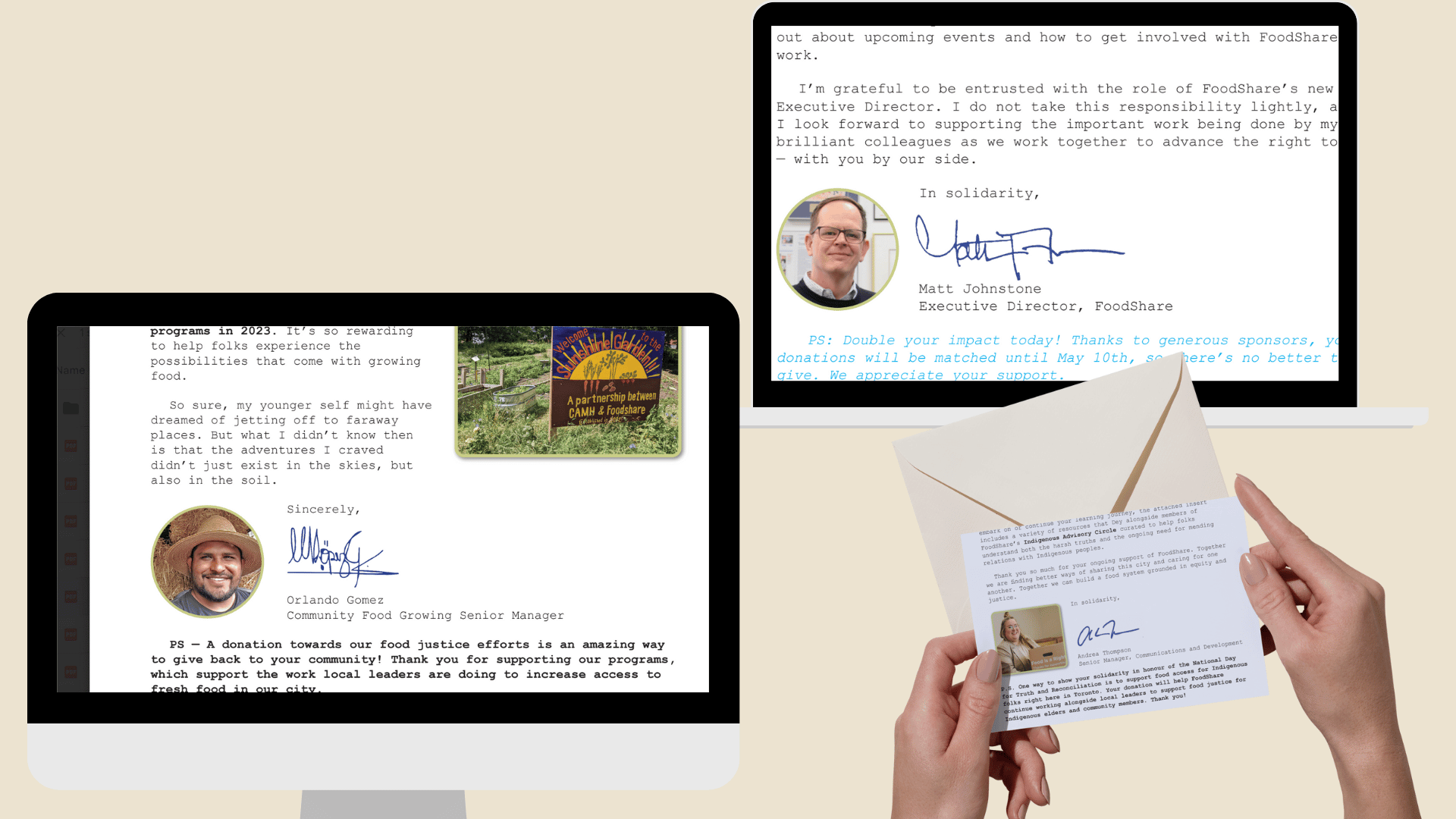
Messages from a variety of different “voices” at FoodShare
Create opportunities to take action
People like having things like the recipes and growing tips, but they also appreciate other ways to take action in their community. So we send our donors the same kind of calls to action that we do to our broader community around petitions and ways to get involved, letters, city council, things that are going on so that they can feel kind of connected to that work.
Channels
When we talk about channels, it’s not only about where we are showing up, but how we use those channels tactically. We show up in most of the common places. In terms of revenue, 71% of our monthly revenue is coming from online, and 66% of our monthly donors are coming from online so online is the primary channel.
The key thing is that to us, donors are members of our broader community. We find, particularly with our monthly donors, that they already had some kind of touchpoint, not necessarily as a volunteer or like that kind of proximity, but just they’d heard about us on the news or saw us at a webinar. So being a new donor doesn’t necessarily mean that they are new to the FoodShare community.
When we bring on “new donors” we try to bring them on board more strategically and get people to understand the scope of the support we need as well as the collective impact that we can achieve.
We don’t use “thank yous” and acknowledgements alone. But you might hear us say things like, “thanks to the hard work of community leaders in Flemington Park, and the generous ongoing support of donors like you, we’ve been able to turn this half acre unused hydro corridor into a flourishing urban farm.”
Beyond that we also look at creative ways to build touch points with a range of values-aligned stakeholders. One example of that would be working in collaboration with Canada’s Great Kitchen Party, where we are the beneficiary of the raffle tickets that they sell there and we actually show up, we sell the raffle tickets ourselves and we get to talk to people about our work.

Andrea and Tiffany at Canada’s Great Kitchen Party, sharing the message of FoodShare’s work.
Closing Statements:
Our fundraising strategy and monthly donations program was not built in a day. It’s important to manage expectations but at the same time start somewhere by providing the option. It’s only in the last 6-8 years that we’ve meaningfully seen an increase in monthly donations. Getting started – that’s our biggest advice.
Q&A Round-up
How can we get started with asking for monthly donations?
Start with having the option. Provide a range relative to the one time gifts that you are seeing. When your charity has the capacity to analyse the data or do further donor segmentation, you can adapt your range to the capacity of specific donors segments.
What is your communication frequency?
For our monthly donors, they are included in newsletters that are sent about 4 times a year. Monthly donors are “low-maintenance” in the sense they already understand and believe in the cause. We have a mailout at the beginning of the year with tax receipts and include an insert.
We might segment there with an “upgrade ask”. Besides that, we include our monthly donors in a couple of our year-end emails and include occasional asks for one time gifts.
What is in the content of your communications?
It is really focused on the impact and making folks feel that they are meaningfully part of the work we’re doing. There’s no specific length, it’s about getting people excited about what you’re doing.
What are some tips for teams strapped for capacity?
Tactically, adding monthly to an already existing fundraising program, does not require a lot of standalone work. You can take what you’re doing for one-time gifts and you’ll find that they really complement each other. Be realistic about your capacity and use some of the tools that are readily available.
One additional starting point could be engaging your Board of Directors or leveraging your volunteers. On that part, they could be engaged in thank you campaigns, phone calls and more.