GivingTuesday and December may still feel far away, so is it too early to start thinking about Giving Season? Absolutely not. That doesn’t mean you need to launch your campaign tomorrow or start filling your donors’ inboxes with year-end asks. It means now is the time to get prepared, while you still have room to think strategically.
Giving Season can sneak up quickly in organizations of every size. Fundraising teams are still managing grants, programs, events, donor relationships, communications and all the other work that doesn’t disappear just because year-end is approaching. And let’s be real, year-end isn’t only busy at work. We’re human. We’re also planning holidays, attending events, managing family responsibilities, wrapping up the year and trying to find a little time to enjoy it ourselves.
The goal isn’t to have every duck perfectly in a row today. But you should probably identify the ducks, get them somewhere in the vicinity, and have them ready to move. Future-you will be grateful.
This blog was written by Nichole Yamchuk of Advocate Fundraising.
Start with the Ask and the Impact
Before you open Canva, write six emails or start planning social media posts, figure out what you’re actually asking people to support.
Try finishing this sentence:
This Giving Season, we’re asking our community to help us __________.
If you’re struggling to fill in that blank clearly, spend some time there first. Your organization’s mission explains why you exist, while your Giving Season campaign gives your community something specific to help you accomplish.
Then find the proof. Look for a real story from your organization that demonstrates the impact of the work you’re asking donors to support. Maybe it’s a person who found community through your seniors program, a family your organization supported during a difficult transition, an animal that found a home, or a program that started small and now has a growing waitlist. You’ve already done something worth supporting, so show people. The heart of your campaign can be incredibly simple: this is what we’ve done, this is what happened because people supported us, and we need your help to keep doing it.
Imagine an organization supporting isolated seniors. Their everyday donation messaging might say, “Your donation helps us provide programs and services that improve the lives of seniors in our community.” It’s true, but vague. What if instead we meet Margaret, who began attending a weekly community meal after months of spending most days alone? She started coming for lunch, stayed for the conversation, and a few months later was arriving early to help welcome other seniors. Now connect that impact directly to the ask: “This winter, we’re working to make sure 100 more isolated seniors have somewhere to belong. Your gift helps provide weekly meals, transportation and community programming throughout the coldest months of the year.”
Now your donor understands what the organization does, sees evidence that it works, and knows what you’re asking them to help make possible next. You’ve given them something to say yes to.
Of course, storytelling needs to be ethical. Use informed consent, protect people’s dignity, use strengths-based and inclusive language, and think about whether the person being featured would feel proud and respected reading the campaign themselves. The people you serve are not fundraising material. Their stories are theirs first.
Shift from Everyday Fundraising to a Giving Season Campaign
Your organization probably already has year-round fundraising messages. Maybe your website says “Donate Today,” your newsletter includes a regular donation button, and your social media occasionally reminds followers that donations support your work. Keep those things. Giving Season isn’t about throwing away your everyday fundraising message. It’s about giving people a timely and specific reason to act on it.
Think about the difference between “Support our seniors programs” and “Help 100 seniors stay connected this winter.” The mission hasn’t changed. The fundraising opportunity has.
That transition shouldn’t suddenly appear on GivingTuesday. Start preparing your audience for year-end giving in September. Introduce the need you’re seeing, share impact from the year so far, tell the stories that will eventually anchor your campaign and remind people what community support makes possible. You’re building context before increasing the frequency and urgency of your asks later in the season.
Your communications should also work together. Your newsletter can introduce a story and explain the bigger picture. Email gives you room to make a direct ask and follow up as the campaign progresses. Social media can showcase impact, short videos, campaign milestones, behind-the-scenes moments, donor gratitude and reminders. Direct mail can reach donors who prefer something tangible. Your website and donation page bring all of those pathways together.
You also don’t need every communication to scream “DONATE NOW.” A strong Giving Season campaign includes a mix of storytelling, impact, gratitude, progress and direct asks. One post might introduce the person or program behind the campaign. The next might celebrate reaching 25% of your goal. Your newsletter might go deeper into why the need has increased, while your next email makes a direct ask. Together, those touchpoints build the campaign.
Whether someone finds you through Instagram, opens your newsletter, receives a letter or clicks through an email, they should recognize the same Giving Season campaign and understand what you’re inviting them to help accomplish.
Give Your Community Something to Rally Around

Once you’ve identified the impact and the ask, consider setting a clear campaign goal. Maybe you’re trying to raise $10,000 to expand a program, $25,000 to support another 100 people, or enough funding to deliver a specific service throughout the winter. A goal gives your community something tangible to work toward, and it gives you something incredibly valuable too: content.
If you’ve reached 25% of your goal, that’s an update. If 50 donors have participated, celebrate it. If you’ve crossed the halfway point, tell people. If you’re $2,500 from the finish line, that’s another reason to reach out. Someone who donated earlier may even see that you’re close and decide to give again. A good campaign gives people opportunities to feel part of something that’s happening.
Here’s where preparing early makes your life considerably easier: create the bones of those communications now. You don’t know today that you’ll be at 63% of your goal on December 12, and that’s fine. Draft the template, create the social graphic with a placeholder, prepare the email and build your progress update. When the campaign is live, you’re inserting the current number, adding a fresh detail and hitting send. Preparation doesn’t mean predicting exactly what will happen. It means making future execution easier.
Explore a Matching Gift Before You Launch
While you’re preparing, look at the relationships you already have. Is there a major donor, corporate partner, funder, board member or community business that might be willing to provide a matching gift? Even a modest match can strengthen a Giving Season campaign. A $2,500 partner doesn’t need to fund your entire $20,000 goal. Their commitment could create a one-day matching opportunity where every donation up to $2,500 is doubled.
Suddenly, your communication isn’t simply asking someone to donate. You’re giving them an opportunity to make their contribution go further. A match creates a legitimate reason to act now without manufacturing urgency, and it gives an existing donor, funder or community partner another meaningful way to participate.
This is also why we don’t wait until GivingTuesday morning to start thinking about GivingTuesday. Matching partnerships take conversations, so start those conversations early.

Write for the Potential Donor, Not Your Organization
Once you’ve written your campaign materials, change seats and imagine you’re the potential donor. You didn’t attend the planning meeting, haven’t read the strategic plan, don’t know your organization’s acronyms or internal terminology, and might not know very much about the organization yet. This email simply arrived in your inbox. Would you give?
Ask yourself whether you understand what you’re being asked to support, whether the story makes you care, whether you can see how your donation contributes to the goal, and whether you know what to do next. Just as importantly, consider whether the language actually invites you into the work. Use inclusive language that welcomes donors into a community working toward something together rather than positioning the organization as the hero and the donor as the wallet.
And write like a person. Charities sometimes develop a very particular way of communicating: “Your generous contribution will enable our organization to continue delivering vital programming to vulnerable populations.” Now imagine saying that to someone sitting across the table from you. You probably wouldn’t. You might simply say, “More families are asking us for help this year, and we don’t want to turn anyone away.” Same need, completely different feeling.
Before anything goes out, get someone else to read it. This matters even if you’re an experienced writer. Ask someone who wasn’t involved in creating the campaign whether they understand the ask, whether anything feels confusing or unclear, and what they think you’re asking them to do. A second set of eyes can catch missing information, strange wording, broken logic and assumptions that are obvious to you only because you’ve been living inside the campaign for weeks. Don’t make yourself a one-person review team if you don’t have to.

Make It Easy to Say Yes
Someone wants to support you. Fantastic. Now don’t make them work for it. Online giving should be simple, your links should work, and the message on the donation page should clearly connect to the campaign that brought the donor there.
If your organization uses CanadaHelps, use the tools already available to you. Campaign and donation pages give you an easy way to create a clear online destination for the campaign without building a whole new fundraising system. Make sure the page reflects your Giving Season message, then actually test the donor experience yourself before sending people there.
Build a fully branded, mobile-friendly form in just minutes, designed to increase giving.Looking for Donation Forms That Bring in More Donors?
But don’t assume everyone wants to give online. Some donors aren’t comfortable entering financial information online. Others may have accessibility barriers, limited or insecure internet access, or simply prefer another method. Alongside your online donation option, clearly provide information about other ways to give where available. Include a mailing address for cheque donations and contact information for someone who can answer questions or help a donor make their gift. Depending on your organization, you might also accept donations by phone, in person, through securities or other methods. The point isn’t to create seventeen donation methods. It’s to avoid accidentally turning away someone who has already decided to support you.
Then test everything. Click the links, try the donation form on your phone, make sure your contact information is current, and review the experience for accessibility. Use alt-text, caption videos, choose readable fonts and contrast, and make buttons easy to identify. Your donor shouldn’t need instructions to donate.
Your Giving Season Timeline: What to Do and When
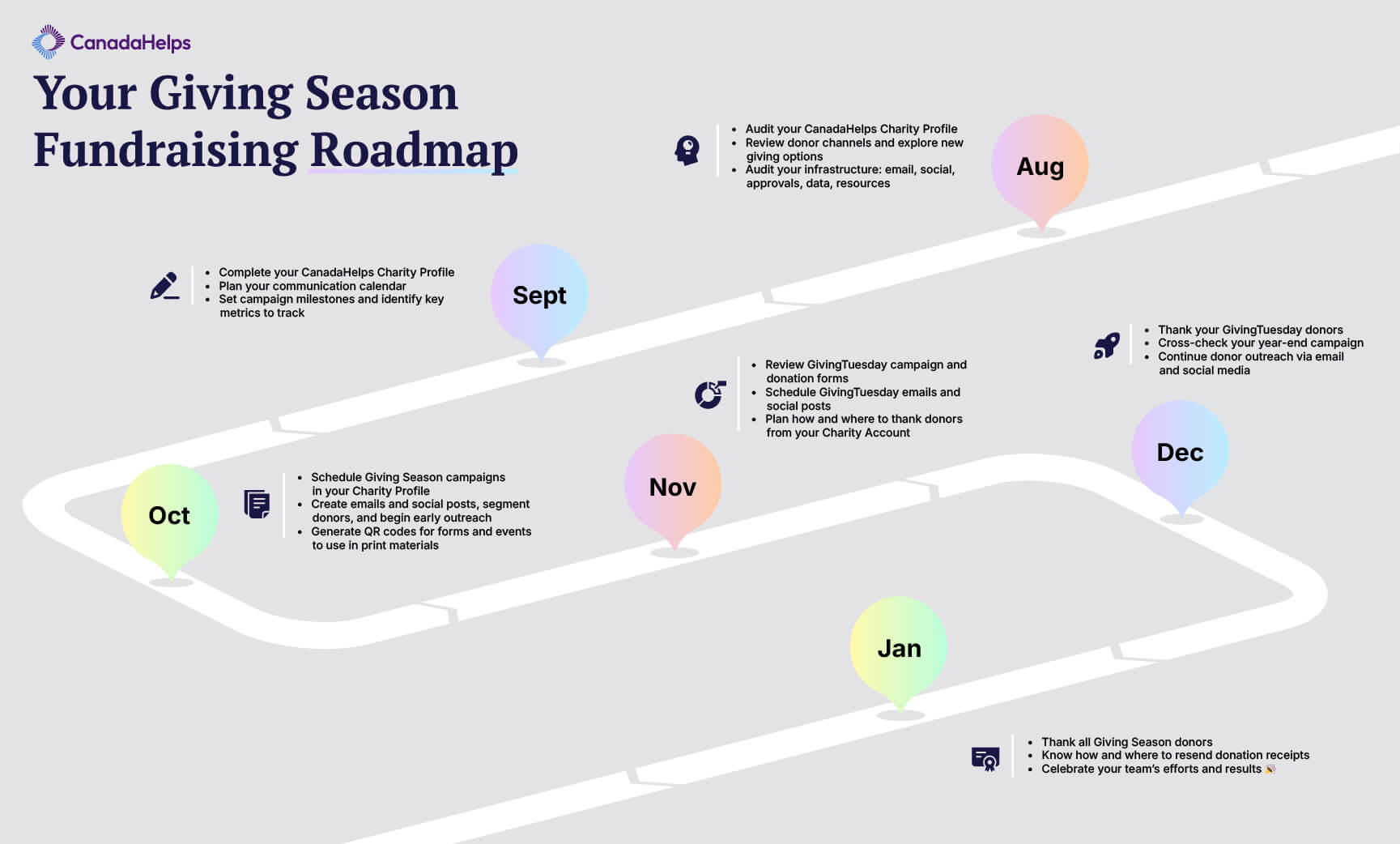
You don’t need to do everything today, but you should know what’s coming. CanadaHelps’ Giving Season Roadmap begins well before year-end for good reason. Infrastructure comes first, followed by planning, campaign development, launch, continued outreach and donor stewardship. Here’s how to turn that into an actionable fundraising timeline.
- August: Get Your House in Order. Review your website, donation pages and CanadaHelps Charity Profile. Make a test donation, check your email list and donor information, and identify obvious gaps in the donor journey. Start thinking about the campaign itself too. What could you fundraise for? What recent impact can you demonstrate? What stories might support the campaign? Who needs to approve those stories? Are there photos you have permission to use? You don’t need a finished campaign yet. You need to know what you have and what you’re missing.
A complete, updated profile helps build trust and increase donor confidence.Update Your Charity’s Public Profile on CanadaHelps
- September: Build the Campaign and Start Preparing Your Donors. Choose your campaign focus, set your fundraising goal, identify the core impact story and secure consent. Identify potential matching donors or partners and start those conversations. Create your campaign calendar, determine who owns each task, and finalize the central campaign message. This is also the time to start transitioning your communications toward year-end. Share impact from the year, introduce the needs and opportunities your organization is seeing, and start telling the stories that will make the eventual fundraising ask feel like a natural continuation of a conversation rather than something that suddenly appeared in December.
- October: Create Before You’re Busy. Write your emails, draft social media content, prepare newsletter and direct-mail copy, build campaign and donation pages, and create graphics and templates. Don’t only create launch content. Prepare progress updates, milestone graphics, thank-you content and final-week reminders too, leaving placeholders wherever you need live information later. Schedule what you reasonably can, test every link, and get someone outside the campaign to review the copy and donor journey. The more you prepare now, the less you’re creating from scratch when Giving Season gets busy. You can find templates and easy ways to get started directly on CanadaHelps Giving Season Hub.
- November: Build Momentum. Increase the visibility of the campaign across your channels. Tell the story, make the ask, share progress, celebrate donors and activate your board, volunteers and community partners. GivingTuesday falls on December 1 in 2026, so November is your runway, not your waiting room. By the time December arrives, your audience should already understand what you’re trying to accomplish and why.
- December: GivingTuesday, Year-End and the Final Push. GivingTuesday on December 1 is an important fundraising moment, but it isn’t the finish line. Continue communicating throughout December with progress updates, impact, gratitude and clear opportunities to participate. December 31 is also a major giving day because many donors are thinking about making charitable gifts before the end of the tax year. That’s okay. Organizations don’t need to be awkward about it or pretend it isn’t part of donor behaviour. A tax benefit isn’t the reason your mission matters, but it can absolutely be a reason someone chooses to make the gift today rather than next month. Remind supporters of the December 31 deadline for donations they want receipted for the current tax year, while keeping your mission and impact at the centre of the message.
- January: Thank, Report Back and Keep the Relationship Going. Your automated confirmation after a donation is your first opportunity to thank someone, so don’t waste it on generic transactional language. Use real words. Express genuine gratitude. Remind the donor what they’ve just become part of and what their support is helping make possible. Gratitude shouldn’t wait until January either. Thank supporters throughout the campaign. Celebrate milestones, recognize the community that’s showing up, and continue connecting donations back to impact. When the campaign ends, send a dedicated thank-you to everyone. Tell them how much was raised, how many people participated, what was accomplished and what happens next. Use photos and stories where appropriate so donors can actually see the result of what they helped create.
- Beyond January: Then follow up again. A spring impact update is a great opportunity to return to your Giving Season donors and say, in effect, remember what you helped us do? Here’s what has happened since. That’s especially important for new donors. Don’t let their year-end gift become their first and last interaction with you. Invite them into ongoing communications, share impact throughout the year and give them opportunities to stay connected that aren’t always attached to another ask. Retention doesn’t start with next year’s GivingTuesday campaign. It starts with how you treat someone immediately after this year’s gift.
Prepare Now So You Can Fundraise Later
Nobody needs extra year-end stress. By November and December, your team is still running programs, supporting your community and managing year-end responsibilities, while probably trying to have some version of a personal life too. There are holidays, family commitments, events and all the normal things that don’t disappear because GivingTuesday showed up on the calendar. We’re all human.
You don’t need every duck perfectly lined up today. Identify them, get them somewhere in the vicinity and know which ones are likely to wander off. Get the major decisions made and prepare whatever you reasonably can in advance. When Giving Season arrives, you’ll still be busy and fundraising will still require some responsiveness in real time, but you won’t be building the entire campaign while trying to run it. You will thank yourself later.
And if life happens anyway? We know it will. Maybe September disappeared, your October campaign plan never made it out of the Google Doc, or it’s suddenly November and GivingTuesday is staring you directly in the face. You’re not out of time.
Need support getting your Giving Season campaign ready? Advocate Fundraising can help you build the strategy, messaging and fundraising plan behind your year-end campaign. Book a 15-minute Giving Season fit call.
If you’d like to find more resources to help you prepare for Giving Season, find them in our Giving Season Hub. All the tips, templates, and inspiration for your year-end giving housed in one place.