GivingTuesday is the world’s largest generosity movement, and arguably the most important day of the annual fundraising calendar for charities. In 2024, charities raised $16.2 million on GivingTuesday, surpassing the number of donations received on December 31st through CanadaHelps. And the previous year, in 2023, GivingTuesday represented 3.5% of all annual giving on CanadaHelps.
As the number of charities participating in GivingTuesday on CanadaHelps continues to grow, from 28% in 2018 to 42% in 2024, we wanted to explore how charities can continue to stand out during GivingTuesday, engage younger donors, and maximize their fundraising results from this movement.
Keep reading, and learn from fundraising experts Victoria Leonhardt and Nicole Danesi. This blog is adapted from our recent webinar “Ditch the Last-Minute Panic and Rock GivingTuesday Instead,” with key highlights from the presentation and a round-up of questions from our charity audience.
Watch the webinar in full here.
What is GivingTuesday?
GivingTuesday is a day dedicated to generosity. This movement started in 2012 following the realization that we have two days dedicated to consumerism on Black Friday and Cyber Monday, but without a day dedicated to giving. CanadaHelps is a proud co-founder of the GivingTuesday movement and we have been leading it in Canada ever since.

Beyond this one 24-hour period dedicated to giving, it is also the kick-off to the giving season and a time to create momentum for giving that goes far beyond the day itself.
Why Should Charities Get Involved with GivingTuesday?
Charities participating in Giving Tuesday on CanadaHelps have grown from 28% in 2018 to 42% in 2024. However, while participation in GivingTuesday has grown exponentially, there is still a significant proportion of charities that are unconvinced about the value of participation or where to start. We wanted to dedicate some time to exploring the benefits of participation and busting a common myth around GivingTuesday!
- GivingTuesday doesn’t just mean “earlier donations of money we would have seen on December 31st”. Our research shows that many of the donations that come in on GivingTuesday are net new donations – above and beyond what would have come in on Dec 31st.
- Overall, giving is trending downwards (you can read more about it in our Giving Report), so it’s clear that we need to build a pipeline of sustainable giving in order to reverse this trend. GivingTuesday is one way to do this, as our research shows that GivingTuesday appeals to younger supporters who are looking to be part of a bigger movement.
- GivingTuesday represents roughly 3.5% of annual giving on CanadaHelps each year. In the last year, it actually surpassed December 31st in terms of giving.
- There is a big difference between charities that participate in GivingTuesday and those that don’t. Charities that participate in GivingTuesday, based on our data and insights, generate 6.2x more revenue in the period between GivingTuesday to December 31st.
- GivingTuesday also goes beyond fundraising; people participate in all different ways of giving – giving money, items and time. It’s important to see GivingTuesday as a day of generosity. 36% of Canadians gave all 3 last year, which means that often your volunteers are also the ones who might support your charity financially or vice versa.
How Are Charities Getting Involved with GivingTuesday Around the World?
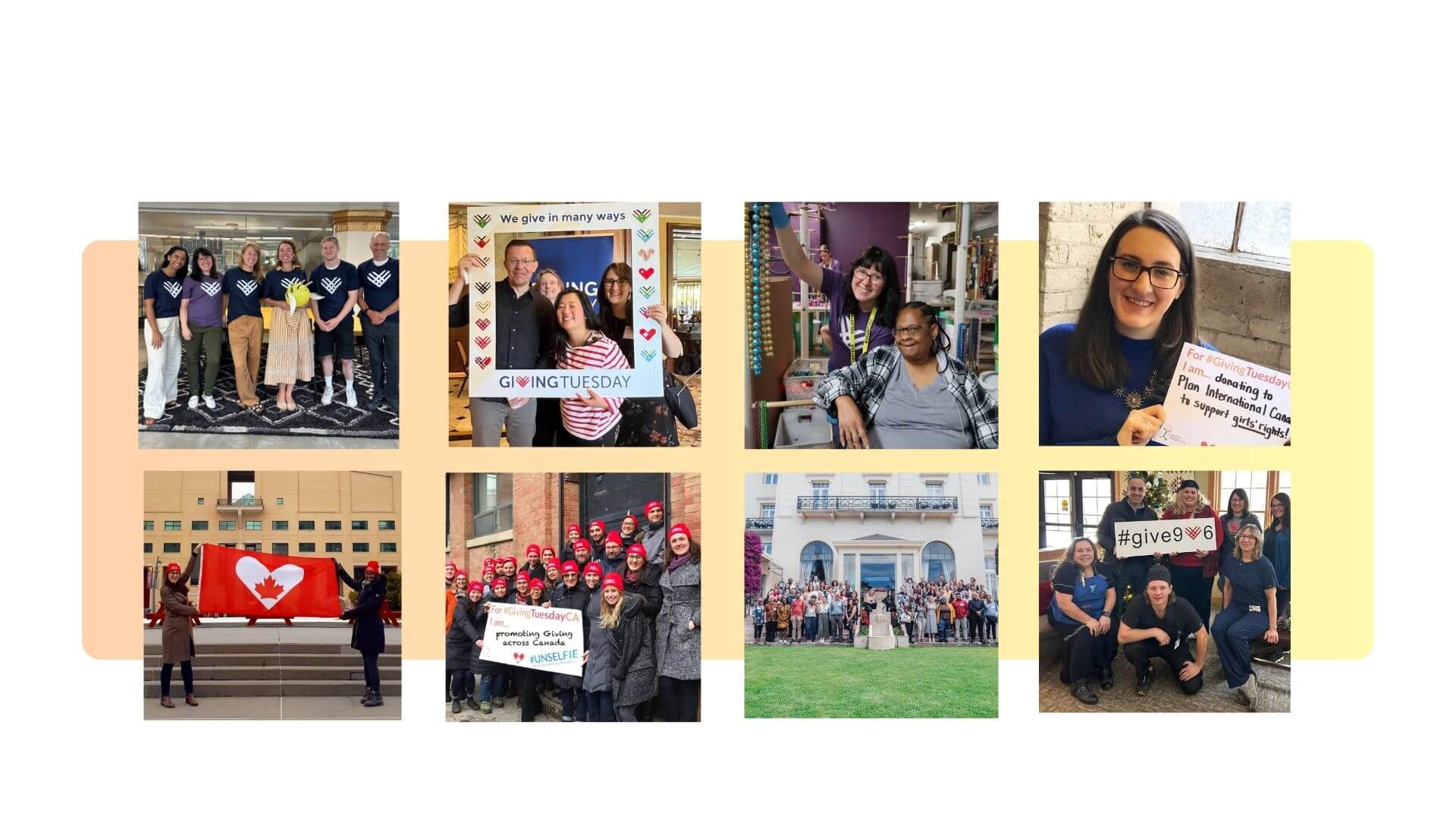
So how do you stand out from the crowd? There are many ways to get involved with GivingTuesday. To fully benefit from the movement, it’s important to go beyond a simple social media post on the day. Here, we look at 4 creative ways charities have tapped into the GivingTuesday movement.
Partridge Creek Farm (Michigan): Used a tiered donation goal with specific milestones and pivoted to a donor match mid-campaign, greatly exceeding their target. For their first-ever GivingTuesday, they set a goal to raise $5000 to purchase land. They also outlined tiered goals, such as $6500 that would allow them to do maintenance, $8000 to install a new fence, and $10,000 to enable them to buy tools for garden members.
Unexpectedly, a long-time donor offered to provide $5000 for matching gifts as well, so they jumped on this opportunity, adapting mid-campaign, to advertise this match. Another supporter followed their campaign closely and made an extra donation around midnight on GivingTuesday to ensure they hit their highest tier goal.
This is a fantastic example of how running a specific campaign can help you reach your goals, no matter the size of your organization. Ultimately, Partridge Creek Farm managed to fundraise $10,850, enabling them to reach all of their targets and empower their urban farm community.
Streaming in Italy: GivingTuesday Italy brought together a number of streamers on Twitch. They realized that these streamers have really powerful communities. So each streamer supported a charity of their choice, and they had a really successful campaign, deepening authenticity and community engagement among younger supporters.
This kind of campaign could work well if you have a streamer in your community or you know that there’s a streamer who cares about your cause. This could be a really fun way to engage, especially the younger generation of new donors, in what you’re doing.
Lasagna Love: Lasagna Love mobilized a network of volunteer chefs to make and deliver lasagna to those in need. They created mini fundraisers, meal drives, and other creative acts of generosity. A major part of this was the social media aspect, where they gave a platform to those volunteer chefs to go live on their own Instagram and share what it was like to build the lasagna and be involved. All of this helped to build excitement around a simple act of generosity and is a great example of a campaign that could work well for charities with a large volunteer base.
This campaign pulled together different ways of participating in generosity; it had the mini fundraiser element, used volunteers as ambassadors, developed meal drives, and is a really creative way to think about how we can be in community and use those networks to spread awareness, excitement, and engagement around what we’re doing.
Search for Common Ground – “The Things We Carry”: The global organization Search for Common Ground created a campaign called “The Things We Carry”, tying together storytelling, community gathering and digital activism.
The campaign engaged both donors and non-donors, integrating GivingTuesday into a broader end-of-year campaign. In terms of fundraising, this campaign raised $904,000 from 158 new donors. Engagement metrics for their campaign include just over a million impressions with about 10,000 engagement points, and 10,000 video views across their social platforms.
The success of this campaign shows the power of GivingTuesday to go beyond a single day.
Quick-fire Tips on Getting Started with GivingTuesday
- Set clear goals. As in the Partridge Creek Farm example, those goals made it clear what the aim was, helped the charity to measure the success of their campaign and motivated their supporters with tangible outcomes.
- Develop a campaign that goes beyond the 24-hour period. Make it a year-round message and use GivingTuesday as a moment to amplify and celebrate generosity.
- Messaging should be human, actionable, and community-focused. Understanding where communities “hang out” (online or offline) is crucial to align outreach effectively.
- Offer multiple ways for supporters to give. Campaigns can include fundraising, volunteerism, item donations, and acts of kindness to provide various on-ramps for generosity.
- Leverage volunteers and ambassadors. Train select volunteers, board members, or influencers to represent and promote the campaign within their networks, enhancing reach and engagement. Amplify their stories both locally and digitally to create new, engaging content.
- Secure matching gifts. Matches may come from corporate partners, major donors, or board members. Matches motivate donors and boost fundraising. Some of our charity partners have seen success even with modest match amounts ($1,000 to $10,000).
- Re-engage previous major donors early. Reach out to your previous donors well before GivingTuesday – this could be a potential source for your matching gifts.
- Encourage feedback and community support during your campaign. Engaged donors want to help beyond giving money, offering perspectives and talents to overcome organizational hurdles.
Our In-Depth Q&A Roundup from Charities about GivingTuesday!
We had a lot of questions in our webinar and wanted to ensure they were answered. Please find below a roundup of some of the unanswered questions from our Q&A:
Why does having a younger demographic of donors matter? Whether they’re older or younger, why is the demographic important for sustaining a charitable organization?
This speaks to a lot of research Canada Helps has published in the Giving Report. When you think about the long-term view of your organization, it’s important to think beyond the here and now of your annual fundraising goals. It’s also how we build a community around our nonprofit, so that 10 or 20 years from now, when older donors may not be there to support your organization, you are set up to tap into a newer community and newer demographics. That’s why we emphasize younger donors when building a pipeline of supporters.
We also recommend engaging supporters in a number of different ways. It’s a challenging economy, and some people may not be able to give to you financially, but there are other ways individuals can still support your cause. Your supporters shouldn’t only be a pocketbook for your organization. You need to tap into them in a number of different ways to gain support.
How do people donate on GivingTuesday? Through the charity directly or via the CanadaHelps site?
You can ask your supporters to get involved in any way you usually receive donations; GivingTuesday is a movement that you can tap into as part of your fundraising campaign, rather than a platform for donations.
CanadaHelps provides fundraising tools to help charities process online donations quickly, securely and easily. Check out our fundraising tools today and use them for your GivingTuesday campaigns.
Also, think about all the different ways you can engage your supporters, including non-monetary ways. Even though it is an important fundraising day, the mix of touch points you have with your supporters, not only on GivingTuesday, but throughout the rest of the year, is important. Calling and thanking your supporters goes a long way to building that relationship.
Should charities email our list of existing donors the GivingTuesday campaign info and link?
Yes, we absolutely encourage charities to email their current donors about their GivingTuesday campaign. You can make use of resources off the GivingTuesday page. There are graphic assets, a communication toolkit and more that you can access. We are currently working on email templates that you are welcome to copy directly from and edit (this blog will be updated shortly).
What language would you recommend charities use to initiate corporate matching gifts?
In terms of verbiage, describe how the match clearly and how it will work to amplify their impact. Showcase how far the support could go, and the change it would bring. Many organizations and decision-makers are results-focused. So, ‘do the math’ in terms of understanding the input of both time and dollars, and how those numbers can help your organization make the case for a match.
How do charities that have very few individual donors, with more funding coming in from foundations, leverage GivingTuesday?
It varies. With foundation grants, you’re using donations that might have limitations around how those dollars are used. Depending on the donation, there could still be creative things you do with this. For example, if acceptable to the foundation, you could leverage it as a match to try to go out and acquire new donors.
Another example is where one foundation flipped it and did a gratitude-crawl – they went to their sponsors from a recent event of GivingTuesday and thanked them in person. If these foundations are close by, you could use GivingTuesday to focus on building your relationships with them, reaching out and saying thank you.
Bearing privacy policies in mind, is it acceptable for charities to email previous donors?
In Canada, we have CASL law governing email subscriptions, but there are caveats that exempt charities participating in fundraising activities. While you should always refer to the most up-to-date information from the Canadian Government, CASL exempts commercial electronic messages (CEM) sent by registered charities if the primary purpose of the CEM is to raise funds for the registered charity.
What tactics are best for list-building during GivingTuesday?
One tactic you could consider is a simple quiz for your organization or cause to help you acquire new emails. For an environmental charity, for example, use online tools or platforms to build a simple, straightforward quiz to educate people about the environment. It will allow people to engage with your cause in a different way, where they’re learning something. Then, at the end, ask them for their email. If a person takes the time to go through the whole quiz, they’re clearly invested in your cause, and they want opportunities to join your community. And that is the perfect tactic to build those supporter lists differently.
Another is adding an email subscription list on your website. Many organizations are not doing this yet. That is table stakes. That’s an easy, consistent list builder!
How do you find a matching donor? Is it advised to go after someone who has already given a lot this year, or focus on a large new donor?
Reach out to your biggest supporters and let them know of the opportunity to amplify their support. Refer to their past giving behaviour and ask them whether they would be willing to donate the same amount as a match gift. You might also reach out to new donors with potential, such as corporations that are aligned with your goals. Try a few different avenues!
What are the best practices to attract younger donors? Do you have guidance/data on what types of donations they best respond to?
There are a lot of incredible young people all over the world who are fundraising for charities and advocating for the work that charities do. They’re interested and excited to get involved – givingtuesdayspark.org is the global resource hub for all things youngest generation.
Our data for young people in the U.S. between 18 and 30 shows they’re the least solicited group, but the most likely to respond to a solicitation. Likeliness to respond decreases as people age, but the rates at which they’re asked increase as they age. In the U.S., the people who are asked most are the ones giving the least. And the people least asked are the ones giving the most.
In ‘State of Generosity’ in Canada, older generations report giving the most. Gen Z and Millennials are right around 50%.
In terms of tactics or methods for how demographics are giving, inside the 2022 or 2023 Giving Report, we dove into demographic giving differences between generations. It’s a good resource, and even though it is about two or three years old, it has not changed drastically. You can refer back to it to get an understanding of how people are giving.
Younger donors may be more open to the idea of monthly giving because they’re used to a subscription model of making transactions.
Securities donations are also going up among a more financially savvy group that understands the tax benefits of securities donations. The Giving Report has some nice numbers around securities donation and how this trend is growing. You can easily accept securities using the CanadaHelps Securities Form, where we take care of receiving the security, liquidating it and disbursing it to you without you having to lift a finger.
How do you know when the fundraising support you are seeking is null? For example, when is the cut-off to stop reaching out to large donors who are not giving?
There will always be times that people don’t respond or it just isn’t the right time. When you’ve reached out a few times, it’s ok to send a last-call type message and let them know to reach out if things change. You may continue sending them touchpoints and updates.
Should we send out messages in advance of GivingTuesday?
Yes, it is always advised to start ahead of time to get folks interested and invested in your cause.
Want to Learn More About GivingTuesday?
For a full, live version of our GivingTuesday webinar “Ditch the Last-Minute Panic and Rock GivingTuesday Instead”, including an exclusive presentation from Nicole Danesi, Senior Manager of CanadaHelps Communications and Brand, and Victoria Leonhardt, the Senior Manager of US and Canada for GivingTuesday Global. You can view the slides from their presentation here, and watch the webinar in full here.